Category: Uncategorised

Smokers at greater risk of severe respiratory disease from COVID-19

Emerging evidence from China shows smokers with COVID-19 are 14 times more likely to develop sever respiratory disease.

If you smoke, you are not only putting yourself at greater risk of developing sever disease from the COVID-19 virus, but those around you exposed to second hand smoke, including children, are also put at increased risk.

Smoking tobacco is known to damage the lungs and airways causing a range of severe respiratory problems. The evidence clearly shows COVID-19 virus attacks the respiratory system, which explains why smokers are at greater risk. A small but highly impactful survey from China finds that smokers with COVID-19 are 14 times more likely to develop severe disease.

In addition, the repetitive hand to mouth movement provides an easy route of entry for the virus, putting smokers at greater risk of contracting COVID-19.

Professor John Newton, Director of Health Improvement at Public Health England said:

“In light of this unprecedented COVID-19 pandemic, there has never been a more important time to stop smoking. Not only for your own health but to protect those around you. It will also help alleviate the huge pressures on the NHS”.

“It is never too late to quit, no matter your age”.

Once smokefree, there are very real health benefits with the body continuing to repair the longer you stay smokefree. The more immediate benefits include:

  • after 48 hours carbon monoxide is eliminated from the body. Lungs start to clear out mucus and other smoking debris
  • after 72 hours breathing becomes easier as bronchial tubes begin to relax
  • after 2 to 12 weeks blood circulation improves, making physical activity like walking and running easier

To help reduce your risk of contracting the virus and developing severe disease from coronavirus, you can use the smokefree app to access advice and support on how you can best stop smoking. Search ‘Smokefree’.

Follow the Smokefree Action Coalition

Home Working and Young Workers

While the world battles COVID-19, everyone who can is now having to work from home. For young workers and their managers this may present additional considerations and challenges to be overcome.

Workstation and DSE

The HSE have advised that for those working from home temporarily home workstation assessments are not needed.

page1image14367280

Younger workers could well be living at home or in shared accommodation so are more likely to have to work where they can, as opposed to choosing where would be the most suitable place. As a result their workspace may have distractions and not allow for the ideal IT set-up. Things to consider:

  • Does the employee have the correct IT kit, for example screen, mouse?
  • Does the employee have a desk or makeshift desk? Is space for a desk set-up available? Can a kitchen table be used, for example, if a desk isn’t available?
  • Can the employee work comfortably? Will using cushions make the seating more comfortable?
  • Does the employee know how to get help with IT or kit issues?
  • Breaks should be taken from DSE work (a minimum of 5 minutes each hour).
  • The employee should change position regularly, get-up and stretch.
  • If an employee doesn’t have the correct work equipment, breaks should be taken every 25 minutes to stretch.

Work

Younger workers who are less experienced in their roles will need additional support. This may be both in terms of their existing work and to help maintain their motivation over extended timescales when working from home. A lack of support in times of increased pressure or changed work situations could exacerbate stress and anxiety.

page1image14355296
  • Can the planned work be completed safely; are control measures needed?
  • Speak to employees and find out if they have concerns about their work while based at home and address these as soon as possible.
  • Encourage employees to let you know if they have any queries, questions or worries.
  • Make sure they have access to and are familiar with procedures, processes etc.
  • Encourage interaction between team members. Would it be helpful for a more senior employee to mentor a younger team member?
  • Are they motivated? New or different work may help with motivation and prove to be a positive distraction.
  • Discuss and agree daily aims and goals.
  • Make frequent contact.
  • Use online meetings, video calling and training.
  • Think about your tone and wording.
  • Listen carefully to their tone of voice, are they feeling stressed or anxious?

Wellbeing

page2image13634288
  • Regularly check that your employees are ok, keeping in place lines of communication and detecting if they are becoming stressed or feeling down.
  • Support communication between team members.
  • Encourage employees to:
    • define work and rest time
    • set up a designated workspace
    • get dressed
    • write a daily to-do list
    • contribute regularly to team chats/group emails and encourage ‘non-work’ conversations.
    • ask for support when needed.
  • Put in place an emergency point of contact, where they can get help if they need it.
  • If an employee is ill, they should take time off.
  • Encourage employees to do some sort of exercise at lunch time even if its walking round the kitchen or stretching.
  • While there is a degree of confinement, encourage employees to find something they enjoy doing, which is within therestrictions.Stress and anxiety
  • Offer confidential support if an employee is feeling anxious or stressed.
  • All employers have a responsibility to ensure the health, safety and welfare of their employees. In the current climate there is possibly little which can be done to alleviate their feelings of anxiety, but by being there and listening you may help them.
  • Be mindful that an employee may have a family member who is ill, or a family member who is classed as vulnerable.
  • Promote wellbeing and a culture which encourages staff to make this their priority.
  • Know where to get further help or where to direct an employee to.

Driver CPC Periodic Training

The Government has announced temporary changes to professional driver requirements as part of its response to the COVID-19 pandemic.

During the coronavirus outbreak, it may be difficult for drivers to complete their periodic training. The Department for transport has therefore put in place temporary changes to professional driver qualification requirements.

Professional lorry and bus drivers whose Driver Qualification Card (DQC) expires in the period 1 March 2020 to 30th September 2020 can continue driving.

Drivers should continue to carry their expired DQC during this period. More information about the updated guidance and keep up to date with all official government advice on COVID-19.

First aid cover and qualification during the coronavirus outbreak

If first aid cover for your business is reduced because of COVID-19 or you can’t get the first aid training you need, there are some things you can do so that you still comply with the law.

You must review your first aid needs assessment and decide if you can still provide the cover needed for the workers that are present and the activities that they are doing. 

Keep enough first aid cover

If there are fewer people coming into your workplace it may be safe to operate with reduced first aid cover.  You could also stop higher risk activities.

Share first aid cover with another business

You could share the first aiders of another business, be sure that they have the knowledge, experience and availability to cover the first aid needs of your business. 

Shared first aiders must:

Whoever provides the temporary cover must make sure they do not adversely affect their own first aid cover. 

First aid cover and qualification during the coronavirus outbreak

Fit testing face masks to avoid transmission: COVID-19

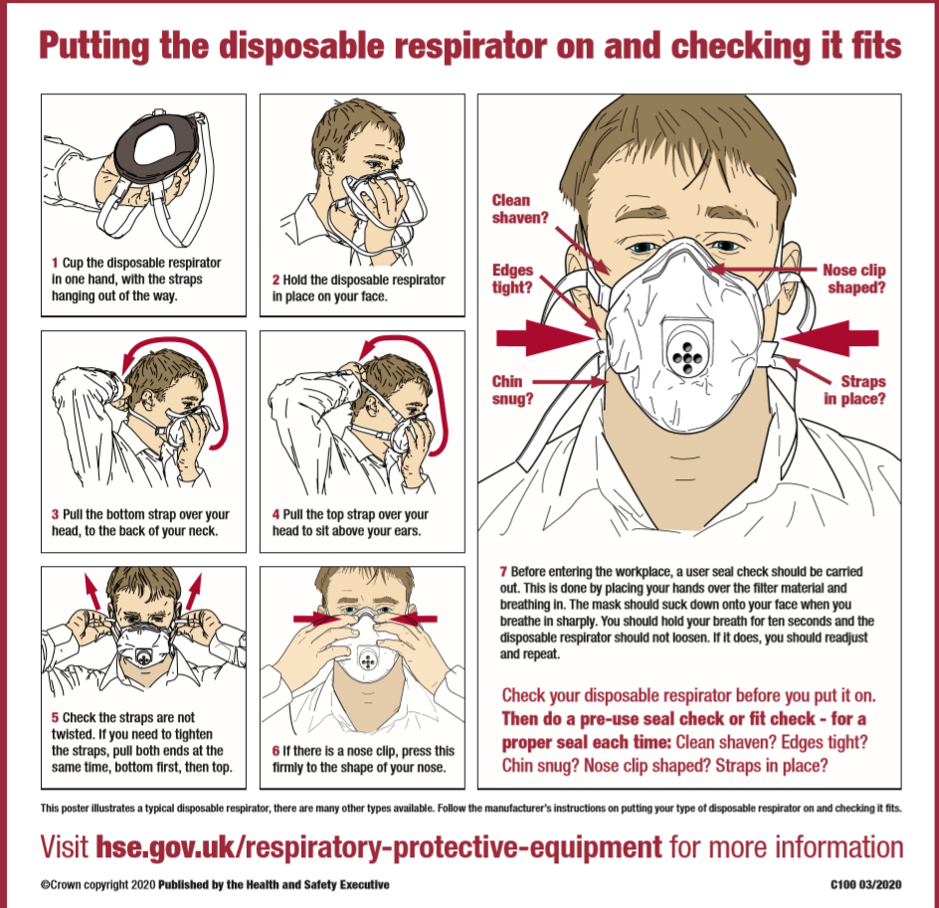
Tight-fitting respiratory protection equipment (RPE), for example disposable FFP3 masks and reusable half masks rely on having a good seal with the wearer’s face. A face fit test can be carried out to ensure the respiratory protective equipment (RPE) can protect the wearer.

To ensure you put on tight-fitting RPE correctly, use a mirror or ask a colleague.  Fit-testers should follow government advice on social distancing, as they can make observations from as safe distance and deliver instructions verbally. 

The user must carry out a pre-use seal check or fit check. 

Take a look at the poster below which gives guidance on how to put on disposable respirators and how to do a pre-use seal check or fit check. 

Using disposable respirators – poster (PDF)

For more information fit testing masks to avoid transmission: COVID – 19 see  HSE guidance

Guidance on respiratory protective equipment (RPE) fit testing: INDG479

Access to workplace facilities for drivers

All drivers must have access to welfare facilities in the premises they visit as part of their day to day work activities.

There have been several reports that some drivers are not being allowed to use welfare facilities when they arrive on site.  

Forbidding access is against the law.  With the latest advice for hands to be washed regularly, failure to allow access to welfare facilities may increase the risk of COVID-19 spreading.  

Companies who already provide reasonable access to toilets and handwashing facilities should continue to do so.  

Advice on homeworking for employers.

Do you have people working from home temporarily as a result of the COVID-19 outbreak?

As an employer, you have the same health and safety responsibilities for home workers as for any other workers.

The HSE has a wealth of advice on how you can work to reduce the risks to your employee’s health and well-being. 

Latest COVID-19 Information & Guidance

In light of the COVID-19 outbreak, there are a range of Coronavirus (COVID-19) public information materials available for you and your employees.

Keep up to date with COVID-19 developments and the latest news.

Sign up to the latest Government updates here

COVID-19 latest information and advice.

Are you and your employees looking for information on the latest UK Government measures around Coronavirus?

If you employ people, the GOV.UK guidance for employers and business provides up-to-date information on how you and your workers can prevent the spread of COVID-19.

The Government website also provides up-to-date information about the situation in the UK and guidance for the public on the risk from Coronavirus (COVID-19).